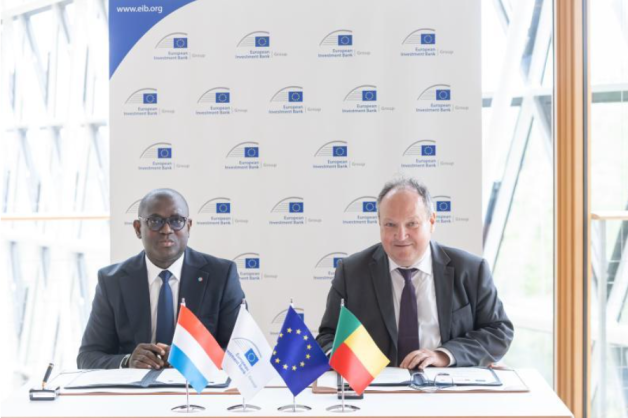
- EIB and BIIC deploy €100 million in financing, guaranteed by European Commission, in support of agricultural value chains that are key for Beninese economy and European industries.
- Operation strengthens strategic sectors – cotton/textiles, soya and cashew – that are essential for agro‑industrialisation and job creation in Benin and for security and diversification of EU supply chains in line with the EU Global Gateway strategy.
- Financing agreement signed under “Women for Stronger Communities and Growth” initiative to support economic resilience of women and communities in face of climate change and food insecurity.
- A Luxembourg-funded technical assistance programme will support the growth and sustainability of local businesses, particularly those led by women.
The European Investment Bank (EIB), via its specialised arm for development and international partnerships – EIB Global – and the Banque internationale pour l’industrie et le commerce (BIIC) today announced the start of a strategic partnership aimed at strengthening financing for Beninese small and medium-sized enterprises (SMEs) and mid-caps, with integrated agricultural value chains as the main priority.
The €100 million operation, backed by a guarantee from the European Commission, is part of the European Union’s Global Gateway strategy, which aims to reduce the investment gap in infrastructure in partner countries for smart, clean and secure connections and, in particular, to secure and diversify global supply chains while promoting high environmental and social standards and local transformation.
Strategic value chains at the heart of the partnership
The partnership, dedicated to companies in agrifood value chains in Benin, focuses primarily on three key sectors for Benin and trade with the EU:
- Cotton and textiles: A pillar of Beninese exports, this sector indirectly supplies European markets via international processing chains. Strengthening local processing capacity helps shorten and secure the EU’s textile supply chains while improving their traceability.
- Soya: With soya a key element for agrifood and animal feed in Europe, the development of local processing makes it possible to diversify supply sources and reduce dependence on certain global suppliers amid tensions on agricultural markets.
- Cashew: Because cashew is an important raw material for the European agrifood industry, moving up the value chain locally (sorting, processing) fosters more resilient, traceable value chains that comply with European requirements.
In total, at least 70% of the financing will be dedicated to these three sectors, helping to build more integrated value chains between West Africa and the EU.
The operation is part of BIIC’s strategy to strengthen its role as a preferred partner of the Beninese private sector and to provide long-term support to companies for their investment projects and working capital needs through attractive financing conditions, particularly in terms of maturity and cost of credit. BIIC was supported by OBARA Capital for the structuring and implementation of the operation.
The first beneficiaries of the cooperation include:
- Akiyo, a Beninese company specialised in trading agricultural products, in particular soya and cashew, which has received financing from BIIC to strengthen its sourcing and distribution activities. Based in the commune of Savè, it helps structure marketing channels for strategic agricultural raw materials for regional and international markets, with particular attention to female employment.
- Couleur Indigo, a textile-sector player based in Ouidah, has been supported in developing its production site for indigo-dyed fabrics. The company, in which women make up a significant proportion of the workforce, contributes to the development of a higher value‑added local textile industry, linked to the processing of Beninese cotton and integration into more sustainable value chains.
Technical assistance for sustainable agricultural value chains and women’s inclusion
A technical assistance programme, supported by Luxembourg through the Financial Inclusion Fund, will complement this partnership with a view to maximising its impact. The programme will support the upgrading of the targeted agricultural value chains by strengthening BIIC’s capacity in sustainable finance, particularly with regard to environmental, social and governance aspects. It will also support local SMEs and cooperatives, particularly those led by women and young people, in structuring bankable projects, improving their business practices and adopting recognised international standards. The programme will thereby help facilitate their access to finance and strengthen their integration into more sustainable and resilient regional and European value chains.
Please consult the press release of the European Commission for more information: EU Global Gateway strategy: EIB and BIIC strengthen strategic agricultural value chains for benefit of Benin and Europe - International Partnerships