Available in
Related countries
Introduction
Since the first edition of the Blended Finance Guidance in 2020, the blended finance industry has experienced significant growth and evolution. Blending is no longer an innovative approach; it is a well-known and widely used method for providers of development finance and the private sector to work together and leverage each other’s resources and knowledge. Yet it still faces important challenges. Blended finance has not scaled as rapidly as hoped and has mobilised relatively limited private finance. It has remained a cottage industry with largely bespoke and fragmented interventions, as well as lack of standardisation and transparency. This updated edition of the OECD DAC Blended Finance Guidance reflects on these challenges and on how the field has changed. It offers strategic advice as well as practical insights for both policymakers and practitioners who want to use blended finance more effectively. The Guidance is based on lessons learned and feedback from many stakeholders. It highlights the importance of working together, building trust through transparency and improving the conditions for investment in developing countries. The Guidance is underpinned by case studies within a range of thematic areas that are critical for blended finance to work more effectively.
What is blended finance?
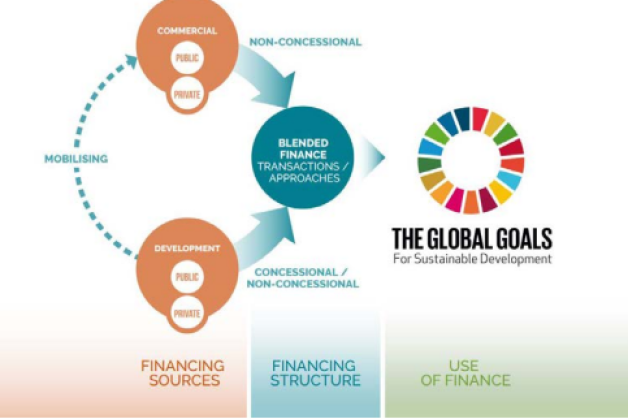
The OECD Development Assistance Committee (DAC) defines blended finance as “the strategic use of development finance for the mobilisation of additional finance towards sustainable development in developing countries”. The definition emphasises the mobilisation of commercial finance with the aim of growing the total pool of finance available for sustainable development in developing countries (Figure 1). Development finance refers to public and private finance deployed with a development mandate. Additional finance refers to commercial finance that does not have an explicit development purpose and that has not primarily targeted development outcomes in developing countries. The development finance used in blended finance transactions can be both concessional and non-concessional.
The OECD DAC Blended Finance Principles
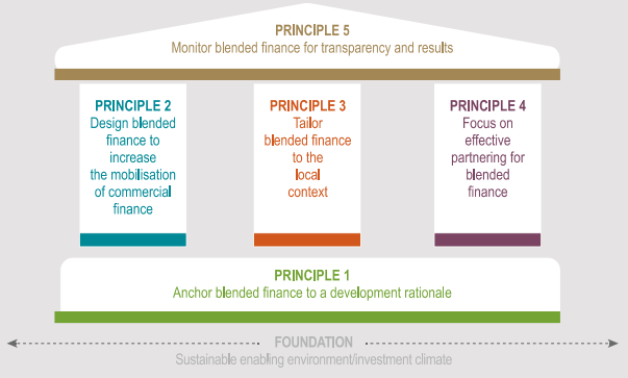
The OECD DAC Blended Finance Principles highlight key elements needed to implement blended finance effectively. The foundation (Principle 1) anchors blended finance to a development rationale. The three pillars are intended to guide implementation, focusing on mobilising commercial finance (Principle 2), tailoring blended finance to the local context (Principle 3) and on effective partnering for blended finance (Principle 4). The overarching theme across all these elements is monitoring blended finance for transparency and results (Principle 5). For blended finance to be effective, all five principles must be adhered to. Lastly, the importance of the enabling environment for blended finance is presented as the foundation of the principles.