Available in
Related countries
Introduction
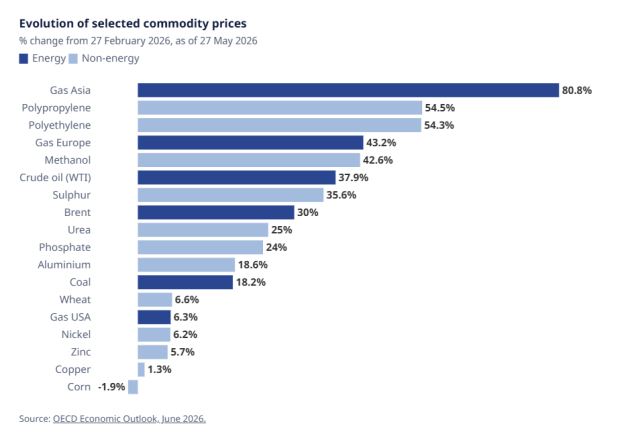
The conflict in the Middle East has become the dominant force shaping the global economic outlook. Energy prices and the prices of other key agricultural and industrial inputs produced in the Persian Gulf economies have soared since February as production and exports have been curtailed. This has been pushing up inflation, putting pressure on real incomes and economic growth. GDP growth projections have been revised down, while inflation has been revised up.
3.4%
⏷
2.8%
Downward revision to projected global GDP growth for 2026
3.1%
⏷
3.1%
No revision to projected global GDP growth for 2027
The longer the disruptions last, the larger the economic and social costs become
The duration and extent of the conflict remain uncertain, but the economic effects are likely to be felt for some time given the months it will take to restore damaged infrastructure and transport routes and deliver products around the world.
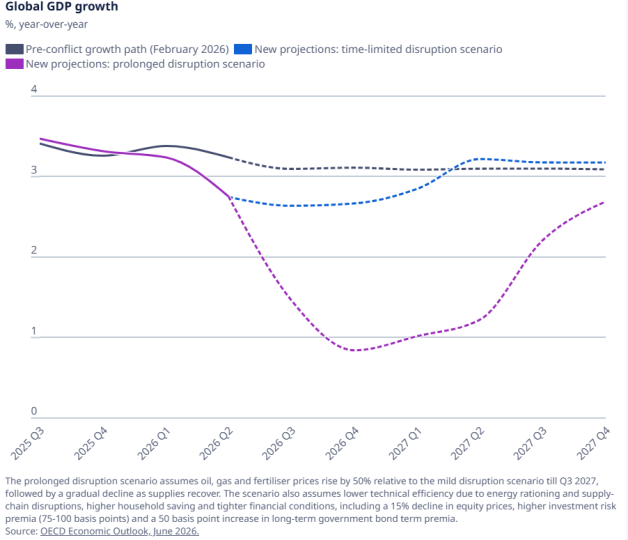
In light of the uncertainty, the Economic Outlook provides two scenarios for the global economy.
In a time-limited disruption scenario, the sizeable disruptions are assumed to remain relatively short-lived, while in a prolonged disruption scenario, broader disruptions last well into 2027, much longer-lasting negative consequences. Both scenarios occur against a background of an otherwise solid underlying momentum in the global economy, with output boosted by strong AI-related investment, production and trade, lower tariff barriers and supportive financial and fiscal conditions.
A prolonged disruption would weigh on growth and significantly raise inflation
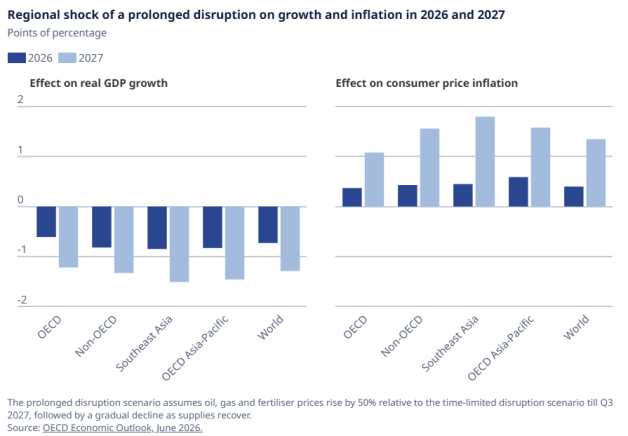
In the prolonged disruption scenario, impacts would vary across regions, with energy‑importing Asian economies particularly exposed given their reliance on supplies from the Gulf.
More broadly, higher energy prices, supply shortages, tighter financial conditions and weaker confidence would weigh on activity worldwide. Inflation would also intensify, rising by around 0.4 percentage points in 2026 and 1.3 percentage points in 2027 – creating difficult trade-offs for policymakers, especially central banks.
What can policymakers do?
Monetary policy should remain vigilant
Central banks in both advanced and emerging-market economies need to remain vigilant and attentive to shifts in the balance of risks around economic and financial developments to ensure that underlying inflation pressures are durably contained. Temporarily higher headline inflation resulting from the energy price shock can be looked through provided longer-term inflation expectations remain well-anchored.
Keep energy relief support temporary and targeted\
Governments responded swiftly to the energy crisis, introducing a wide range of support measures for households and businesses. While these measures have been timely, many have not been sufficiently targeted. Targeting support to vulnerable households and firms can provide effective protection at lower fiscal cost – particularly important given the need to ensure fiscal sustainability in the medium term. As energy prices normalise, support should also be phased out. Beyond being timely, targeted and temporary, measures should preserve incentives for energy saving. If growth weakens substantially, as in the prolonged disruption scenario, fiscal policy will need to provide any necessary stimulus to cushion output given the limited scope for monetary policy to do so.
Access the OECD energy support measures tracker
Strengthen energy security and efficiency
Diversifying energy sources, technologies and supply chains strengthens resilience by reducing reliance on any single point of failure. While this approach raises upfront costs, it helps limit the risks and economic losses from disruptions in an uncertain and volatile environment.