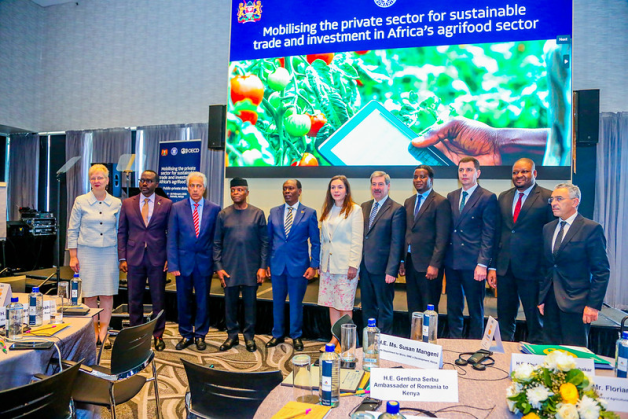
The OECD, jointly with the Governments of Romania and Kenya, convened a high-level public-private dialogue on 'Mobilising the Private Sector for Sustainable Trade and Investment in Africa’s Agrifood Sector' on 9–10 February 2026 in Nairobi.
The two-day event brought together ministers and senior officials from across Africa and Europe, as well as private sector leaders, farmers organisations and international partners for panel discussions, and a capacity-building workshop on the OECD Seed Schemes.
Opening the meeting, Kenya’s Cabinet Secretary for Information, Communication and Digital Economy, H.E. William Kabogo Gitau, underlined that “low productivity and climate pressure are constraining a sector that remains central to the economy,” noting that agriculture continues to face financing gaps, infrastructure deficits and growing climate risks. He emphasised that “public-private engagement is critical to mobilising investment for sustainable trade and long-term growth in agriculture.”
In his opening remarks, OECD Deputy Secretary-General Frantisek Ruzicka highlighted the scale of both the opportunity and the challenge: “Agriculture and food systems account for around 20 percent of GDP in Africa and provide jobs for more than 60 percent of the workforce. Yet the continent remains dependent on global food markets”. He also noted the opportunities of scaling up intra-African trade in agricultural products through the African Continental Free Trade Area.
Florian-Emil Dumitru, Secretary of State at Romania’s Ministry of Agriculture and Rural Development, stressed that “Africa–Europe technology partnerships are essential to improving productivity”.
Across four thematic sessions, ministers and senior officials addressed key challenges and bottlenecks and identified recommendations to unlock sustainable private investment in agrifood value chains.
On finance and investment, participants emphasised the need to reinforce policy frameworks to reduce uncertainty and attract capital sustainably. Given that the agrifood sector currently attracts less than 5% of foreign direct investment to Africa, speakers called for more innovative financing strategies such as risk-sharing mechanisms to expand access to finance for smallholder farmers and SMEs.
On trade and regional integration, discussions focused on implementing the AfCFTA to foster value-added production and resilient regional value chains. Participants underscored the need to shift from exporting raw commodities to exporting higher-value food products, supported by harmonised sanitary and phytosanitary standards, streamlined seed certification systems, and the elimination of non-tariff barriers. Efforts to further harmonise trade regulations and digitising border procedures were identified as key recommendations to reduce costs and incentivise trade.
Sessions on digitalisation and climate resilience highlighted the importance of people-centred digital transformation, moving towards actionable services such as drought early warning systems.
Finally, discussions on skills and entrepreneurship highlighted the need for incentives to position agriculture as an entrepreneurial opportunity for Africa’s youth. Panellists stressed the importance of coherently linking training programmes to market demand and creating regulatory sandboxes to enable innovation.
The Nairobi dialogue concluded with a shared commitment to deepen public-private collaboration, strengthen policy coherence, and scale up sustainable investment to transform Africa’s agrifood sector into a driver of industrialisation, food security and inclusive growth. The outcomes of the meeting will inform ongoing work under the OECD–Africa Partnership and contribute to advancing sustainable trade and investment across African agrifood value chains.
This media advisory was produced for the Africa Virtual Investment Platform by the OECD Global Relations and Cooperation Directorate.