Available in
Related countries
Overview and spotlights
The annual flagship report Africa’s Development Dynamics is a product of the longstanding partnership between the African Union Commission’s Department of Economic Development, Trade, Tourism, Industry and Minerals and the OECD Development Centre. It brings together a team of academic researchers, economists, statisticians and other experts from African and partner countries.
The 2025 edition explores how African stakeholders can accelerate infrastructure development to achieve productive transformation and the Agenda 2063. The first chapter assesses the infrastructure investment needs to accelerate productive transformation and current financing conditions in the face of growing sovereign debt burdens, high cost of capital and declining development finance. It also evaluates the main environmental and social sustainability opportunities and risks associated with infrastructure development. The second chapter proposes priority policies to accelerate the development and implementation of infrastructure projects, drawing on lessons from across the continent and beyond. The ensuing chapters focus on the five African regions as defined by the Abuja Treaty: Southern, Central, East, North and West Africa. These chapters offer a regional perspective on the state of infrastructure, financing flows, infrastructure policies, development corridors, infrastructure project support and skills development.
This edition draws on a wide range of data sources and included primary data collection through semi‑structured interviews and a survey. The analysis was conducted between September 2024 and June 2025, based on available studies and data. The OECD/AfIDA online survey on skill supply in the infrastructure sector was administered to a network of infrastructure developers, investors and experts. Twenty‑eight responses were received by February 2025. Findings were corroborated through an expert workshop with 40 participants on 23 January 2025. Three semi-structured interviews took place in December 2024.
The statistical annex contains the latest economic, social and institutional indicators across African countries for which data are comparable. A list of data tables appears in the last pages of the report. The data are presented by country, region, regional economic community and relevant country groupings (e.g. resource endowment, levels of income, socio‑economic development and fragility, ocean access, and language). The annex provides comparisons between Africa and different world regions as well as other relevant benchmarks. These data aim to inform decision makers, advisors, business analysts, private investors, journalists, non-governmental organisations and citizens around the globe who are interested in the development trajectories of African countries. It is revised online on an ongoing basis.
The full report is published in English, French and Portuguese. Additional figures and tables and the statistical annex are available on the websites of the African Union Commission and the OECD Development Centre.
Investing USD 155 billion per year in infrastructure development could more than double Africa’s GDP by 2040
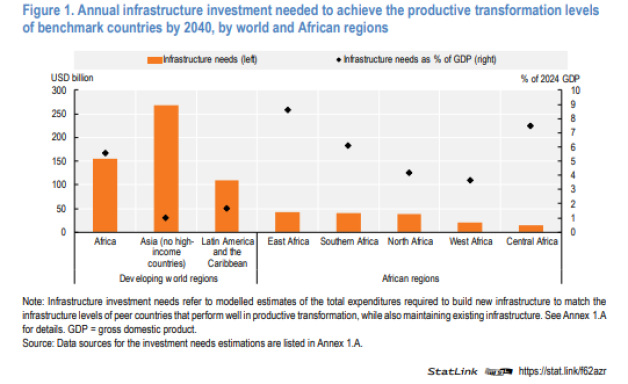
Infrastructure investments of USD 155 billion per year until 2040 will allow African economies to grow faster and achieve productive transformation. This report uses a novel methodology to estimate the investments needed for African countries to match the infrastructure of benchmark developing countries that achieved the highest levels of productive transformation. Focusing on productive transformation – and the related infrastructure investment needs – is strategic to achieve Agenda 2063 and the United Nations (UN) Sustainable Development Goals (SDGs). The results of the report’s methodology suggest an average annual investment need of USD 155 billion until 2040. This annual need is equivalent to 5.6% of the continent’s GDP in 2024. This figure is more than three times larger than that of Latin America and the Caribbean (1.7%) and five times larger than that of developing Asia (1.0%). East and Central Africa are the African regions with the largest infrastructure investment needs relative to their GDP, at 9% and 8%, respectively (Figure 1). Fifty-eight per cent of the investment needed to accelerate the continent’s productive transformation is necessary for building new infrastructure, while 42% is essential for maintenance. This report’s projections of Africa’s infrastructure investment needs are comparable to those of other studies, though the underlying methodologies and research objectives vary.
Infrastructure development is necessary to achieve Africa’s productive transformation and Agenda 2063
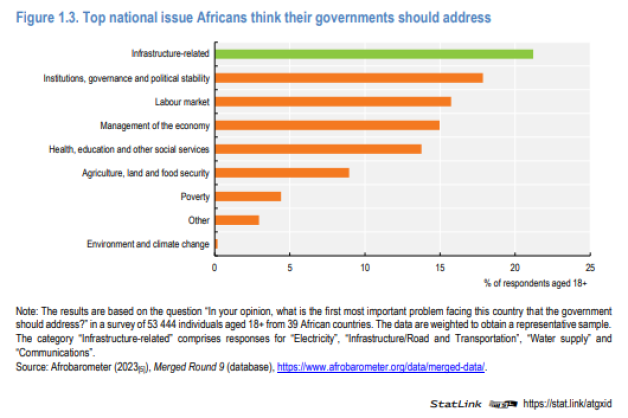
Infrastructure development merits being a top priority for African policymakers, as it can boost growth, trade, job creation and firm productivity. Africans expect their governments to focus on infrastructure as a priority, according to this report’s analysis of findings by Afrobarometer on the top national issue that Africans wish their governments would address (Figure 1.3). Infrastructure is an important enabler of economic growth, regional integration and employment. Since the physical stock of infrastructure is more limited in Africa, infrastructure investments promise larger gains than in other world regions. Integrated infrastructure networks can also boost firm productivity and help deliver well-connected trade networks, contributing directly to the fulfilment of the African Union’s Agenda 2063 vision of “world-class infrastructure crisscrossing Africa” through enhanced connectivity by rail, road, sea and air and through the development of regional power pools and digital networks.
Limited fiscal space and growing sovereign debt burdens constrain African government spending on infrastructure
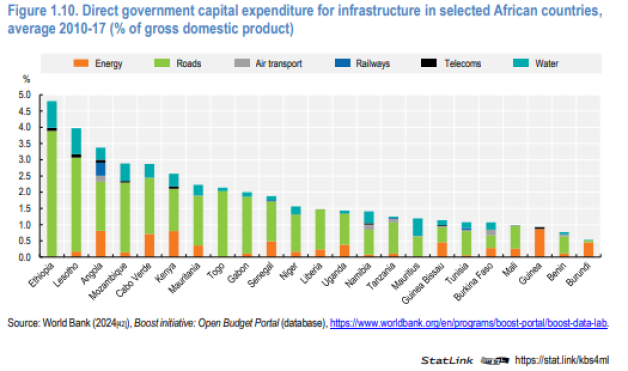
African governments allocate to infrastructure a share of their GDP which is similar to that of other world regions. Over 2010-17, direct budgeted spending from governments ranged from 0.5% to 4.0% of national GDP across 23 African countries, compared to 0.5% to 8.0% across 5 countries in developing Asia and 0.1% to 3.0% across 13 countries in Latin America and the Caribbean (Figure 1.10). This spending is similar to or above the amount high-income countries invest in transport infrastructure (averaging 0.9% over 2018-21) but below China’s and Viet Nam’s average infrastructure investments (at 6.7% and 5.1%, respectively over 2010-14). In addition to direct budget allocations, public spending on infrastructure in Africa is channelled through state-owned enterprises (30%) and public-private partnerships (10%) which often require off-budget interventions such as fiscal injections or contract renegotiation.